How Fitness App Development Is Changing the Way People Exercise
Fitness App Development
Previously the norm was to go to the gym. Many people never sign up for one, but simply download an app and create a plan based upon their own numbers, and then they have a workout that adapts accordingly whenever their numbers change. Much of that change is the result of a solid Fitness App Development Service, subtly reshaping the definition of “working out” for a generation that demands personalization from the get-go, even from their workout.
The convenience aspect is not the only one, although it’s important. It’s a shift in the way people interact with exercise, it’s better than going to somewhere at a specific time, it’s more like a system that is responsive to the people using it. So what is really behind the shift and why it still has a ways to go.
Personalization Replaced the One-Size-Fits-All Plan
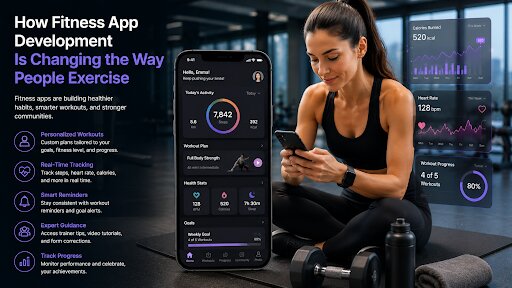
In the past it was common to use a generic workout plan as it meant you had to get a personal trainer, and personal trainers cost money. Apps changed all that about math. Algorithms take into account fitness level, equipment available, injury history, and goals and then adjust the plan week by week based on performance instead of a static PDF handed out on day one.
That’s what flexibility is all about. If it doesn’t change if someone becomes stronger or if he skips three workouts in a row, then it’s not really personalized, it’s just printed on a screen, not on a piece of paper. The applications that are really taking off are those that are not treating a plan as a lifeless piece of paper, but as a living entity.
Wearables Turned Guesswork Into Data
Heart rate, sleep quality, recovery scores, step counts wearables feed all of it straight into fitness apps now, and the apps use that data to make real decisions instead of just displaying it. A high resting heart rate two mornings in a row might trigger a lighter workout suggestion instead of the planned heavy lift. That’s a meaningfully different experience than a paper log where nobody’s checking in until the next gym session.
Apple Watch, Fitbit, Garmin, and Whoop all approach this slightly differently, and the apps that integrate cleanly across multiple devices tend to win more users than the ones locked to a single ecosystem. Fragmented wearable support is still one of the more common reasons people abandon a fitness app within the first month.
Community Features Replaced the Gym Buddy
A lot of people worked out consistently for one simple reason: someone else was expecting them to show up. Apps figured out how to replicate that social pressure without the actual gym. Leaderboards, group challenges, shared workout streaks, and in-app messaging give people the same accountability a gym partner used to provide, minus the scheduling headache of matching two calendars.
This matters more than it sounds like it should. Motivation research consistently points to social accountability as one of the strongest predictors of exercise consistency, and apps that skip this feature entirely tend to see steeper drop-off after the first few weeks, no matter how good the workout content is.
AI Coaching Is Doing More Than Counting Reps
Computer vision in fitness apps has moved well past a basic rep counter. Some apps now analyze form through a phone camera, flagging a rounded back on a deadlift or a knee caving in on a squat feedback that used to require an actual trainer standing in the room. It’s not a full replacement for hands-on coaching, but it catches the kind of mistakes that cause injuries, which is a real gap most home workout setups used to leave wide open.
Voice-guided coaching has improved too, adjusting rest periods and intensity mid-workout based on how someone’s actually performing rather than a rigid script written in advance.
Hybrid Models Are Becoming the Norm
Pure app-only fitness and pure in-person training are both giving ground to something in between. Gyms now offer app-connected equipment, boutique studios sync class data into a companion app, and physical therapists prescribe home exercise programs delivered through an app instead of a printed handout. The line between digital and in-person fitness is blurring on purpose, because both sides work better together than either does alone.
For a business building in this space, the technical planning gets more complex here. Custom workout and training app development cost tends to climb fast once hybrid features come into play syncing with gym equipment APIs, supporting real-time class data, or building out therapist-facing dashboards all add real engineering time beyond a standard workout tracker.
Nutrition Got Pulled Into the Same App
Exercise and nutrition used to live in separate apps, which meant most people just didn’t bother tracking both. That’s changing as fitness apps fold in food logging, macro tracking, and meal planning that adjusts based on training intensity that week. A heavy training week can trigger a different calorie target than a rest week automatically, instead of requiring someone to do that math themselves.
This consolidation matters because friction is the real enemy of consistency. Every extra app someone has to open is a chance to just not bother, and combining the two halves of fitness into one product removes a genuine barrier.
What Hasn’t Changed
For all the technology, the apps that actually work long-term still rely on something pretty basic: making the next workout easy to start. Complicated onboarding, confusing navigation, or a plan that feels overwhelming on day one kills more fitness apps than bad algorithms ever do. The best AI-driven personalization in the world doesn’t matter if someone can’t figure out how to open today’s workout in under ten seconds.
Where This Is Headed
The relationship between the individual and his/her body is becoming more and more an aspect of exercise, and less of an event. The relationship between users and the gym, irrespective of whether it is a membership or not, is mediated by apps. Technology is getting better at figuring out what a body requires at a given point in time, but the apps that get through are the ones that make showing up even for five minutes worth it.